GDZ Weekly – Smart locks, shark skin, and a $1.68B debut
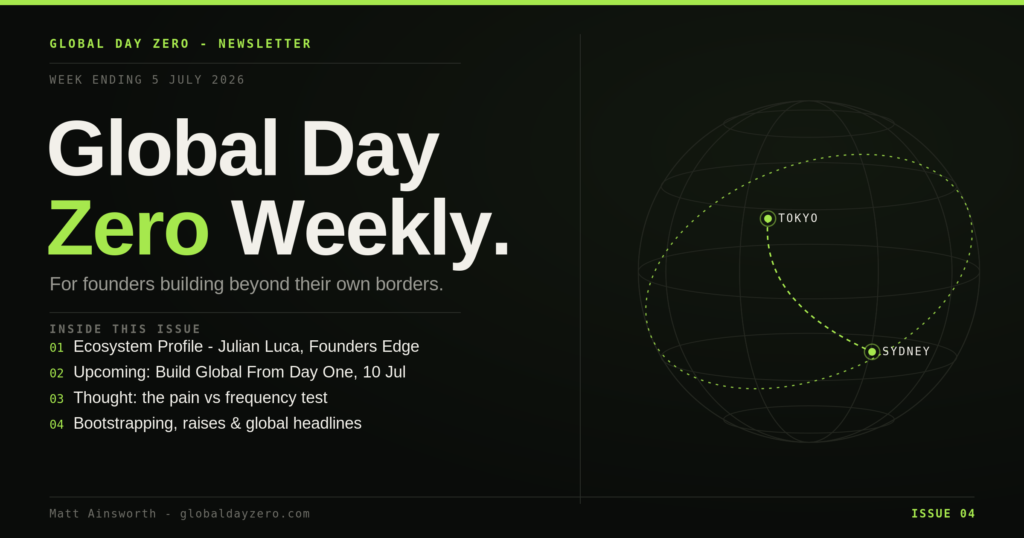
Issue 04 – Week ending 5 July 2026 – For founders building beyond their own borders.
Welcome back to issue 04, kicking off dry July and this week we’re featuring Julian Luca founder of Founders Edge with some exciting news incoming. Through this platform they run regular events, workshops and communities that help startup founders learn, grow, connect and succeed.
We feature the highly successful bootstrapping story from India – Zoho
Japan raises last week included – Bitkey Inc. | 株式会社ビットキー, Money Forward, Inc. (Private Bank), 株式会社スムーズ (Smooth) and more.
Australia was all about space and robotics with raises from – MAKO, Southern Launch, Emesent among others.
Globally we feature – Together AI, Dominion Dynamics, Wultra and Qashier.
Events from GlobalDeel, Global Day Zero and Innovators Campus.
Plus the usual global headlines, thought of the day on validating early ideas and upcoming programs …
Not sure where your idea stands globally? Start with the free assessment with Global Day Zero → globaldayzero.com/#assessment
FX used (approx, early July 2026): A$1 ≈ US$0.69 ≈ ¥112; US$1 ≈ ¥161. Rounded.
Ecosystem profile – Julian Luca from Founder’s Edge
This week we’re featuring Julian Luca founder of Founders Edge – based in Sydney, Australia.
Give us your 15 second intro and what you’re working on.
Hola! I’m Julian, founder of Founders Edge. We run regular events, workshops and communities that help startup founders learn, grow, connect and succeed.
I started my career as an architect before building a travel startup. When COVID put that on hold, I went on to run Innovation Bay’s Angel Network and later the founder community at Fishburners. That experience showed me a huge gap between what investors are actually looking for and the advice many founders receive, so I started Founders Edge to help founders avoid common mistakes and give themselves the best chance of success.
Are you avoiding AI, somewhat into AI, or all in on AI?
Avoiding AI slop, not as deep down the rabbit hole as i’d like to be – but my interns are and hoping they’ll teach me!
What’s the hardest part for startups that want to go beyond their own borders?
We mostly work with early-stage startups, and I actually think the biggest barrier isn’t geographic – it’s getting beyond your own assumptions. I’ve made this mistake myself. Founders naturally become attached to their ideas and convictions, but real progress comes from getting out of the building, having honest conversations with customers and advisors. It often takes a few scars and a lot of wasted time before you realise just how valuable that feedback really is.
Where can people usually find you?
I’m pretty active on LinkedIn, and I work from the free coworking space on Level 1 at Stone & Chalk a few days each week. Otherwise, you’ll find me at Founders Edge events! Should have some exciting ones coming up soon 😋
What’s one thing people find surprising about you?
People can never believe that I was Head Boy of my school
How can you help others, and what do you need help with?
One of the things I’m most grateful for is having a platform that allows us to support so many founders. I’m always keen to hear what challenges people are facing so we can bring in the right experts, speakers and workshops to help solve them. We want to keep our events as accessible as possible for founders, which means sponsorships are incredibly important. Always be happy to chat with partners and see how we can support them.

🌱 Bootstrapping spotlight
Zoho (Chennai, India): The 30-year-old SaaS giant just marked its anniversary with 20% year-on-year revenue growth and 32% customer growth, on roughly US$1.4B in annual revenue – and it has never raised a single dollar of outside capital.
Founder – Sridhar Vembu runs much of it from rural Tamil Nadu and has said flatly the company will not IPO. Proof that you can build a global software business on your own terms, from anywhere. (The Indian Sun) ↗
🇯🇵 Japan raises
- Bitkey Inc. | 株式会社ビットキー : ¥4.0B / A$36M / US$25M (growth, additional round) Digital-key and ID platform for homes and offices; the government-backed JIC VGI top-up pushes cumulative funding past ¥39B. (PR Times) ↗
- Money Forward, Inc. (Private Bank): ¥1.0B / A$9M / US$6M (third-party allocation) AI-powered wealth-management platform aimed at Japan’s ultra-high-net-worth households. (BRIDGE) ↗
- 株式会社スムーズ / Smooth: ¥700M / A$6M / US$4M (Series C, first close) Lets renters split hefty move-in fees into instalments without a credit card; cumulative raise now ~¥4.2B. (JIC VGI) ↗
- iiba: ¥300M / A$3M / US$2M (Series A) Map app surfacing kid-friendly spots for parents, backed by Spiral Innovation Partners and NEXTBLUE. (BRIDGE) ↗
Takeaway: from access to wealth to payments, Japan keeps funding the “boring” rails other markets take for granted, and those rails travel well. Also raising this week: personal-data platform Flows / WeDraft (¥100M seed) (BRIDGE) ↗ and laser wireless-power startup 株式会社SolaNika (seed, undisclosed) (BRIDGE) ↗.
🇦🇺 Australia raises
- MAKO: A$28M / US$19M / ¥3.1B (Series A) Sydney-founded aerospace startup coating aircraft in a shark-skin-textured film to cut drag and fuel burn by up to 4%; led by Virescent Ventures. (SmartCompany) ↗
- Southern Launch: A$25M / US$17M / ¥2.8B (Series A) South Australian spaceport operator running orbital, suborbital and re-entry services; the National Reconstruction Fund tipped in A$10M. (Startup Daily) ↗
- Emesent: A$25M / US$17M / ¥2.8B (equity + venture debt) CSIRO-spun robotics firm whose Hovermap tech maps GPS-denied mines for Rio Tinto, BHP and Glencore; includes the NRFC’s first-ever venture debt. (SmartCompany) ↗
- Fluent: A$2M / US$1.4M / ¥220M (seed) University of Melbourne brain-computer-interface spinout building a sub-scalp implant to help people who’ve lost speech communicate; backed by local and overseas pre-seed funds. (Startup Daily) ↗
Takeaway: space, robotics and now brain-computer interfaces – the week was all deep tech, with government money (NRF/NRFC) crowding in beside VCs. Built at home, aimed at the world.
🌏 Around the world
- Together AI (US): US$800M / A$1.16B / ¥129B (Series C) AI “neocloud” renting Nvidia GPU clusters, now valued at US$8.3B. (TechCrunch) ↗
- Dominion Dynamics (Canada): US$100M / A$145M / ¥16.1B (Series A, C$139M) Ottawa defence-tech firm building Arctic command-and-control and drone systems; the largest defence Series A in Canadian history, led by Georgian. (BetaKit) ↗
- Wultra (Czech Republic): US$7.9M / A$11M / ¥1.3B (Series A, €6.8M) Prague team building post-quantum digital identity for banks and the EU Digital Identity Wallet; led by Seventure Partners. (EU-Startups) ↗
- Qashier (Singapore): US$6.1M / A$8.9M / ¥990M (Series A+) Merchant operating system for Southeast Asia, now profitable on US$1B of annual payment volume across four countries. (TNGlobal) ↗
Takeaway: One US megaround, three very different bets from everywhere else – Arctic defence, post-quantum identity, profitable SEA payments. The interesting capital is increasingly outside Silicon Valley.
🌐 Global headlines
- Bending Spoons debuts on Nasdaq (Italy): The Milan roll-up owner of AOL, Vimeo and Evernote raised US$1.68B and popped ~40% on day one – the biggest software IPO of 2026 and a rare crack in a frozen listings market. (TechCrunch) ↗
- IQM lists on Nasdaq via SPAC (Finland/Germany): The superconducting-quantum maker completed its RAAQ merger at ~US$1.9B to become the first European quantum company on a major US exchange (ticker IQMX). (The Quantum Insider) ↗
- South Korea unveils a US$576B AI-chip drive (South Korea): Seoul, backed by Samsung and SK Hynix, put semiconductors and AI at the centre of national industrial strategy in a bid to own more of the global supply chain. (CNN) ↗
- Google hosts its first Africa Cloud Summit (South Africa): Five new AI and infrastructure moves, including an applied AI lab in Ghana and a connectivity hub linking Africa to Australia via the Umoja subsea cable. (TechAfrica News) ↗
- National Grid backs US AI power (UK/US): National Grid Ventures is investing US$1.75B for a 35% stake in Joulent to build contracted power for data centres, including a Microsoft-supplying plant in West Texas. (Data Center Knowledge) ↗
Thought of the week
A quick framework I keep coming back to.
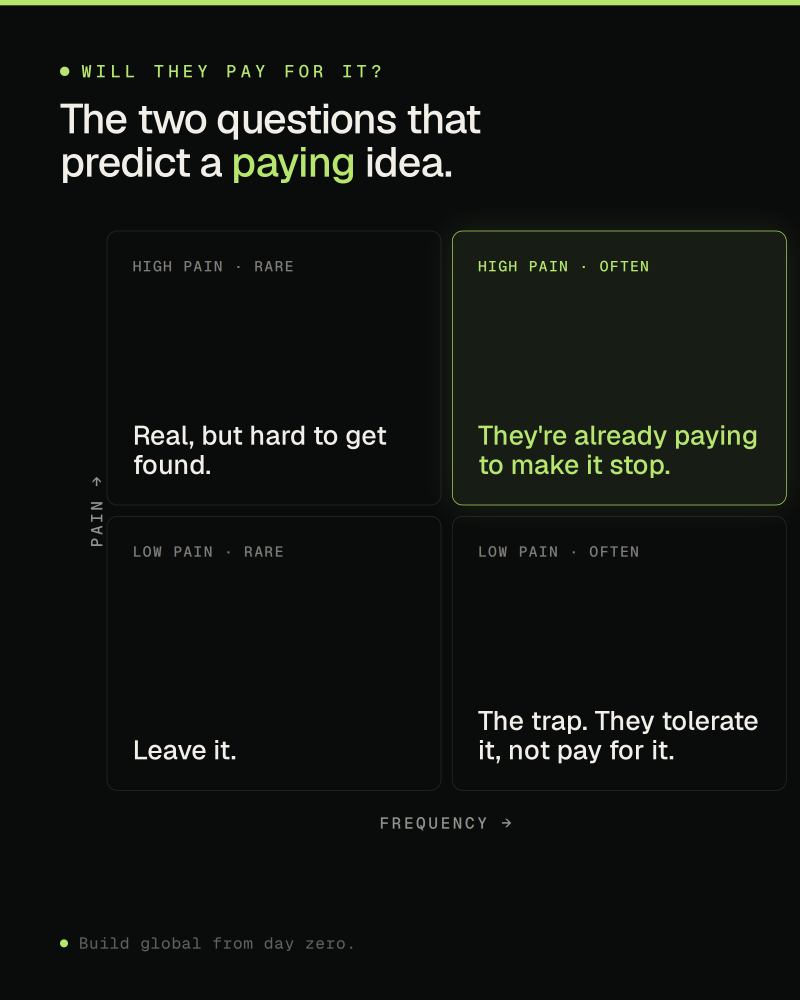
Before you build anything, run the idea through two questions: how often does the frustration show up, and how much does it actually hurt when it does?
- High pain, high frequency is the sweet spot. People are already cobbling together their own fixes and they’ll pay you to make it stop (Zoom when the offices emptied; Stripe back when taking a payment online was genuinely miserable).
- High pain, rare is real, but you’re always fighting to be front of mind for when it finally hits.
- Low pain, frequent is the trap. Annoying enough to notice, not enough to open a wallet, and a lot of clever ideas quietly die there.
- Low pain, rare? Leave it.
It’s a likelihood lens, not a law (plenty of giants came out of that trap corner by selling attention instead of a fix), but for most of what you’re building it tells you the thing that matters first: will people actually pay you to solve this.
The takeaway: once you know it’s a real, painful, frequent problem, the only question left is whether it’s painful in more than one market, because that’s the one worth designing to travel from day zero.
Programs open for application
The Global Day Zero Sprint – an 8-week cohort built to run around a full-time job, that takes the idea you can’t shake and makes it clear, validated and designed to travel from day zero. 8 founders, starts 22 July; applications close 17 July (two spots include 1:1 access).
Not sure where your idea stands globally?
Start with the free assessment. Take the assessment ↗
Upcoming sessions & events
Build Global From Day One – Fri 10 July, 6pm JST / 7pm AEST. Part 1 of the webinar series on designing your product, team and entity to travel from day one, with Karen Onuma-Mielke (@GlobalDeal) and me Matt Ainsworth from Global Day Zero . Register on Luma ↗
The One-Page Test (live) – Thu 16 July, 6:30pm JST / 7:30pm AEST. Ninety minutes to turn the idea you can’t shake into a single page the market can actually answer, so you know it’s worth building before you write a line of code. US$49, credited back if you join the Global Day Zero Sprint. Register on Luma ↗
Build My Deck. Live. – Wed 22 July, 7pm JST / 8pm AEST. Two founders, no deck, 90 minutes: we build both pitch decks live using AI tools and the IC communication framework, with Thom Peace, Matt Ainsworth and Ryan Ahamer. Free, online, seats limited. Register on Luma ↗
The border you build across is a choice, not a constraint. Zoho did it from rural India; Wultra is doing it from Prague. Where you start doesn’t cap where you sell.
Know a founder still building for one market by accident? Forward this to them.
Over to you: which market would you expand into first if capital wasn’t the blocker – and what’s actually stopping you? Tell me in the comments.
TIA – Matt ☕️
No spam. Unsubscribe whenever. I would rather you did that than sat on a list you do not read.
Curious first? Read the back issues →