DMM put ¥5 billion into one robotics startup on its own, Sohan from Edgegenix and our new Free AI Sprint Program!
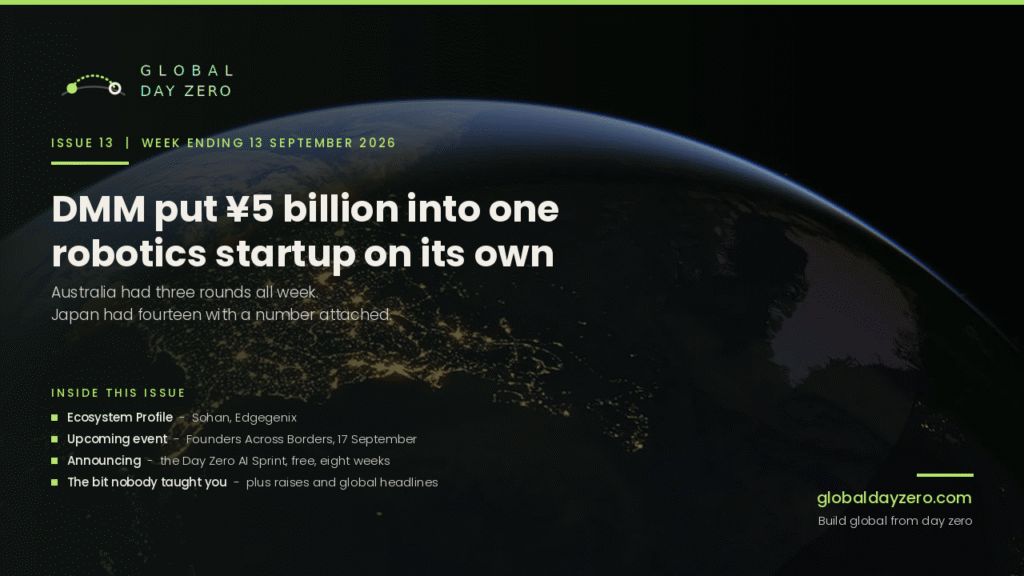
Issue 13 – Week ending 13 September 2026 – For experts building their first product, globally from day zero.
We’re back with another issue – this time celebrating the launch of our new Free 8 Week Day Zero AI Sprint + Community – you can sign-up here.
Featured this week is Sohan Aloysius Domingo, founder of Edgegenix PTY LTD and also part of the current CORE Innovation Hub Core Start program.
Bootstrapping highlight is Open Dental Software and tech of the week is Maven Robotics.
Meanwhile – raises for the past week …
Japan – Algomatic, nocall株式会社 and more
Australia & NZ – Metacognition, First Table and Dela
Globally – Qupital 橋彼道 (HK), Kapital (Mexico), ARC Ride (Kenya), Swish (India) and CloudNC (UK)
Don’t miss our next globinar – when is the best time to go global coming up tomorrow evening.
As well as, our upcoming workshop next week on ‘Upgrade your Buyer, Upgrade your Offer’
Plus, global headlines, thought of the week and more inside!
FX note: rates as at 11 September 2026. A$1 = US$0.72 = ¥110. US$1 = ¥154. Rounded sensibly throughout.
🎙️ Ecosystem profile
Sohan Aloysius Domingo, Edgegenix PTY LTD and BrightBuddy (Sydney). Written Q&A. Answers run verbatim, in his order.
Give us your 15 second intro and what you’re working on.
I’m Sohan from Edgegenix. Most AI vision still needs the cloud. We put it on the edge, on a device at the powerline, the mine site, the fire ground, so it works where there’s no connectivity. Wildfire detection, vegetation encroachment, PPE compliance, asset inspection.
Two things.
The first is the core platform, deploying computer vision models at the edge for wildfire detection, vegetation encroachment along power corridors, PPE and exclusion-zone compliance on mine sites, and roof and powerline inspection. Right now that means turning pilots into signed deals with councils, utilities and fire agencies ahead of the summer fire season.
The second is BrightBuddy, a companion robot for aged care, hospitals and homecare. Same edge AI stack, very different room. We’re also opening up the brain behind it, Buddy Intelligence, so anyone with their own robot hardware can build on it.
What were you doing before this, and what finally made you start?
I ran operations for Dryad across ANZ, and before that I headed the innovation team at Fujitsu. Both roles put me close to the problem, but never close enough to fix it properly. I’ve always been entrepreneurial, starting something was a matter of when, not if. AI made it now. The tools finally exist to build products that weren’t possible three years ago, and that window won’t stay open forever.
The gap I kept running into was that nobody had built a good computer vision platform at the edge. Plenty of models, plenty of cloud, nothing that just works on-site. That’s what Edgegenix is: deploy a computer vision model where the problem actually is, wildfire detection, PPE and exclusion-zone compliance, roof and power line inspection.
The full Q&A also covers why he is sceptical of AI as a demo, what he calls the gap between interest and a purchase order, why bushfire detection and aged care robots run on the same stack, and the intros he is asking for.
→ Read the full Q&A on Global Day Zero ↗

🌱 Bootstrapping spotlight
Open Dental Software (Salem, Oregon). Jordan Sparks is a dentist. He wanted practice management software that was affordable and customisable, could not find one, and set out to write it himself. The first customer paid for support on 22 July 2003. Today the company says an estimated 20,000 dental practices around the world use the program, with a staff of over 150 covering engineers, support techs, trainers and dental professionals. Crunchbase records no funding rounds and no investors against the company.
(The Silicon Forest) ↗ (Crunchbase) ↗
🇯🇵 Japan raises
Algomatic Dynamics (Tokyo): ¥5.0b / A$45m / US$32m (Series A) Physical AI. Motion-data collection and learning, AI robot hands sold with maintenance, and entertainment robots. DMM.com is the only investor in the round. (PR Times) ↗
@HEARTBEATS (Tokyo): ¥2.3b / A$21m / US$15m (Series C) Runs ORICAL, a digital trading-card platform that ties sports and entertainment IP to live, event-timed fan moments. Led by Artemis Venture Partners, with eight new investors and six existing ones following on. (PR Times) ↗
nocall株式会社 (Tokyo): ¥800m / A$7.2m / US$5.2m (Series A) An AI phone agent that makes and takes business calls, specifically appointment confirmations and payment-collection calls. Co-led by JAFCO and Archetype Ventures. Cumulative raised now ¥1b. (PR Times) ↗
SoVa (Tokyo): ¥630m / A$5.7m / US$4.1m (Series B) An accounting firm, not a software vendor. It runs its own tax, labour and administrative practices with technology underneath, at a fixed low price, and has signed 1,300 client companies in three years. ¥210m equity from JAFCO Group and Boost Capital, plus ¥420m of debt from Mizuho Bank and Japan Finance Corporation. (PR Times) ↗
Also raised in window: Experisus ¥400m (debt facility), Akiya ¥370m, MIRROR FIT. ¥250m, Albatross Technology ¥250m, ANRis ¥220m, Medteria ¥140m, POLASTECH ¥140m, 9lione ¥120m, Interbeing ¥50m, Aitane ¥30m. Undisclosed amounts: MILY, Pixeom, GeoDreams, EdTechX, Clean Planet.
Takeaway: four of the fourteen disclosed rounds are AI agents pointed at a specific desk job. nocall does two call types. Aitane does CRM upkeep and pre-meeting prep. Interbeing measures tone and pacing in sales calls rather than transcribing the words. SoVa does bookkeeping and payroll. None of them raised on “AI for business”.
🇦🇺 Australia raises
Three rounds this week:
Metacognition AI (Adelaide, Australia): A$10m / US$7.2m / ¥1.1b (pre-seed) A persistent memory and reasoning layer that sits beneath frontier models, so workers can instruct industrial machinery and power-grid systems in natural language with safety guardrails. Led by Main Sequence. Founded by Anton van den Hengel, Stephen Gould and Paul Dalby, with about ten staff. Forbes Australia calls it a record Australian pre-seed. (Startup Daily) ↗
First Table (Queenstown, New Zealand): A$10m / US$7.2m / ¥1.1b (growth round) Sells off-peak restaurant tables at up to half off the food bill so venues fill seats that would sit empty. 1,500+ Australian restaurants and a million Australian users already. New money from K1W1 and Icehouse Ventures alongside existing backers. The raise funds a Sydney, Melbourne, Adelaide and Perth push. [to confirm: both outlets printed an unmarked “$10 million” with no NZ$ prefix, so this may be NZ$10m] (Capital Brief) ↗
Dela (Sydney, Australia): A$1m / US$0.7m / ¥110m (seed) Escrowed, Stripe-backed payments for second-hand sales on Facebook Marketplace and Gumtree, with seller ID verification and delivery tracking. Free for sellers. Buyers pay $5 under $100. Backed by an unnamed private investor. (Startup Daily) ↗
Also in window: Antioch raised US$32m Series A led by Greylock, with New Zealand’s Icehouse Ventures participating. It is headquartered in New York and co-founded by New Zealander Harry Mellsop, so it sits outside the ANZ count here. The NSW government also proposed a A$150m co-investment fund for university research commercialisation on 10 September.
Takeaway: Metacognition raised A$10m at pre-seed with ten staff and no product in market, on the strength of who the founders are. Anton van den Hengel is Chief Scientist at the Australian Institute for Machine Learning. That is what twenty years of published work buys you at the earliest stage, and it is the closest thing in this issue to a shortcut.
🌏 Around the world
The Exploration Company (Germany): US$450m / A$628m / ¥69.4b (Series C) Building the reusable Nyx cargo and crew capsule and the Storm engine. Co-led by Bessemer Venture Partners, Atomico and the EQT-managed Scaleup Europe Fund. Ten Nyx missions booked and more than US$2b in contracts and commitments, including ESA and NASA. (TechCrunch) ↗
Qupital 橋彼道 (Hong Kong): US$300m / A$419m / ¥46.3b (Series C plus a new MUFG asset-backed financing facility) AI-driven trade financing that puts working capital into the hands of cross-border e-commerce merchants. Led by M Capital. Announced Sunday 13 September, the last day of the window. (PR Newswire release) ↗
Kapital (Mexico): US$125m / A$175m / ¥19.3b (growth financing, equity plus credit) An AI-native business bank that reads small-business invoice and transaction data to underwrite lending. Tru Arrow Partners and Fasanara Capital, with Cervin Ventures, Niya Partners and Overlook Capital. Funds US and European expansion. (Bloomberg) ↗
ARC Ride (Kenya): US$33.3m / A$46m / ¥5.1b (Series A, equity plus asset-backed debt) Electric two- and three-wheelers plus an open battery-swapping network that works across multiple motorcycle brands. Led by Novastar Ventures and Norrsken22, with IFC, British International Investment, Proparco, Musashi Seimitsu and Talanton. (TechCabal) ↗
Swish (India): US$24m / A$34m / ¥3.7b (Series B) Neighbourhood kitchens cooking and delivering fresh food in ten minutes, 250+ SKUs, live in Bengaluru, Gurugram, Noida, Delhi and Ghaziabad. Led by Bertelsmann India Investments with Accel, Bain Capital Ventures and Hara Global. (Entrackr) ↗
CloudNC (United Kingdom): US$20m / A$28m / ¥3.1b AI for CNC machine shops. Its CAM Assist tool generates machining strategies and toolpaths in minutes rather than hours, and it is adding a quoting agent. Deployed in over 1,000 machine shops including Lockheed Martin. Led by Nimble Ventures, with Calculus Venture Capital, Entrepreneur First and Lockheed Martin’s LM Ventures. (EU-Startups) ↗
Takeaway: not one of the six is American, and three of them sell to people who work with their hands. CloudNC sells to machinists, ARC Ride sells to motorcycle riders, Swish sells to people who want dinner. The buyers are specific enough that you could stand in a room and point at them.
🌐 Global headlines
ASML and TSMC commit the chip industry to 12-inch photomasks (Netherlands and Taiwan, 8 September). Moving High-NA EUV off the 6-inch mask that has been standard for decades, with a pilot line targeted for 2031 and production systems in 2033. This is what has to happen before AI chips can get physically bigger. (ASML) ↗
Enflame jumps 188% on its Shanghai debut (China, 11 September). The Tencent-backed AI accelerator maker listed on the STAR Market after a roughly US$911m IPO and closed its first day near a CNY185b valuation. (Nikkei Asia) ↗
Marlan Space and Loft Orbital commit US$1b to a 50-satellite AI constellation (UAE and France, 9 September). The Altair constellation goes from 10 satellites to 50, carrying radar and optical sensors and running inference in orbit for maritime awareness and wildfire detection. First ten launch in October from an Abu Dhabi production line. (Via Satellite) ↗
European founders give lawmakers “100 days to get EU Inc right” (European Union, 10 September). An open letter warns the 28th-regime pan-European company statute is being negotiated down to the point of uselessness. (Tech.eu) ↗
One attacker ran hundreds of AI agents to breach 395 organisations (global, PaperCut is Melbourne-headquartered, 10 September). A single operator pointed a swarm of AI agents at print-server flaws and compromised 440+ instances across 48 countries within hours. Researchers noted some agents improvising off-script. (The Register) ↗
🛠️ Global tech on display
Maven Robotics (Santa Clara, USA) came out of stealth on 10 September with a wheeled robot that does mixed-case palletising, which is the warehouse job of building a custom pallet out of differently sized boxes for one specific retail store. It drives itself around a live facility at 10 mph with staff walking past it, and picks with a vacuum gripper. The number worth holding onto: eight of them have been running 16 hours a day at over 99% uptime inside a Fortune 250 consumer goods customer, with 100,000 autonomous operating hours expected by the end of 2026. Mixed-case palletising is the task warehouse robotics has repeatedly failed at, so an uptime figure from a live site is a more interesting claim than a demo reel. The team came out of Apple’s special projects group, with people from Tesla, Rivian, Cruise and Archer.
(TechCrunch) ↗ (Product footage) ↗
🧭 The bit nobody taught you
You know your industry. You have probably never had to find a customer. One thing a week on product, marketing or sales, for people who have done neither.
Product: your first version can be you doing the work.
SoVa raised ¥630m this week and it is not a software company. It is a registered accounting firm in Tokyo, with its own tax, labour and administrative practices, delivering bookkeeping and payroll at a fixed low price with technology underneath. It describes itself as the Uniqlo of accounting firms, which is a statement about the shape of the business rather than the technology. Three years in, 1,300 client companies.
A first-timer with fifteen years of expertise usually goes the other way. Spend eight months building the tool, launch it, then discover that the people who need it cannot be bothered learning it. The expertise was real and the product was not the thing anyone wanted to buy.
What to do about it: take on five people at a fixed price and do the work yourself, by hand, badly, with spreadsheets. Watch which parts you repeat every single time. Those parts are your product, and you will know exactly what they are worth because someone already paid you for them.
Which part of your job do you do the same way for every client or every case, every time?
😂 Joke of the week
“You know what the biggest problem with pushing all-things-AI is? Wrong direction. I want AI to do my laundry and dishes so that I can do art and writing, not for AI to do my art and writing so that I can do my laundry and dishes.”
Joanna Maciejewska, (on X) ↗
💭 Thought of the week
Thinking about how to define your ICP or target market for your startup, try these 3 gates …
Like? – do you like this person (ie – can you work with them everyday, if necessary)
Help? – can your solution / product actually help this person (solve their problem)
Pay? – can they pay for the product or offer you are building (do they have financial capacity)
🎓 Free programs – Announcing the Day Zero AI Sprint + Community
A free eight week program for people with fifteen or more years in one industry who have built something with AI and have nobody paying for it.
One session a week, one worksheet a week, no build week. Week one leaves you with one buyer and forty real names. By week eight you’ve sent a pilot offer with a price on it and asked someone to pay it.
The community is where people post their numbers. Conversations held, what someone actually said, whether anyone asked the price. Not a place for feedback on your landing page.
Free, self-paced, and you can start whenever.

📅 Upcoming sessions & events
Two live sessions this month, both online, both worth their time in gold.

Founders Across Borders: when is the right time to go global?
Thursday 17 September, 7pm Sydney / 6pm Tokyo. One hour, with GlobalDeal. Most people ask where before they have answered when. The session works through what “ready” actually looks like, the traction and capital signals that matter against the ones people mistake for readiness, and what going too early costs, with Japan as the worked example. Regulated sectors get their own timing question.

Upgrade your buyer, upgrade your offer.
Thursday 24 September, 7:30pm Sydney / 6:30pm Tokyo. Ninety minutes. Most people can describe what they are building. Far fewer can describe who it is for in a way you could act on this afternoon. The session narrows the buyer from a category to a person, then upgrades from whoever has the problem to whoever is bleeding from it and can pay to stop, in that person’s own words rather than the vocabulary twenty years in an industry gives you.
You leave with one page: the result you are promising, the three things in the way, and what gets done about each. Worked live in the room. Bring whatever you have, however rough.
Open Dental’s first customer paid on 22 July 2003. Not a launch, not a round, just one dental practice deciding the thing was worth money. That date is a more useful benchmark than any number in this issue.
Know someone with fifteen years in an industry and an idea they keep not starting? Send them this.
As always, if you’re looking for someone to chat to – reach out anytime for a coffee or virtual chat, I am always happy speaking to founders, new or existing.
Thanks for reading!
Matt ☕️
No spam. Unsubscribe whenever. I would rather you did that than sat on a list you do not read.
Curious first? Read the back issues →